Electrical work is serious, unforgiving business. On a live panel or atop a 30-foot ladder, there is no room for a dropped multimeter or a missing pair of wire strippers. A poorly designed tool belt does not just slow you down — it creates hazards that can cost you time, money, or worse.
This in-depth guide covers everything a working electrician needs to know: the features that actually matter in a trade-specific tool belt, how to compare materials, how ergonomics protect your body over a long career, and detailed reviews of the five best electrician tool belts available in 2026.
Why Your Tool Belt Is as Important as Your Tools?
Most electricians spend years perfecting their tool selection but give almost no thought to how those tools are carried. The result? Tangled wire strippers, buried rolls of tape, multimeters that rattle loose — small frustrations that compound across an eight- or twelve-hour shift into real safety risks.
An electrician's workflow is linear and repetitive: pull wire → strip insulation → terminate connections → test. Every time you have to dig through a deep pouch or shake out a tangle of tools, you break that rhythm. And broken rhythm on an energized circuit is exactly where accidents happen.
A carpenter and an electrician carry completely different tools — long, slim instruments like voltage testers, wire strippers, conduit benders, and multiple rolls of tape. A generic construction belt with large dump pockets is built for hammers and nail guns, not for the fine, linear tools of electrical work. You need vertical tiered structure: narrow, segmented slots that let you grip one tool at a time with a single hand, without looking down.
If you already have a belt and are focused on what goes inside it, see our companion guide on how to organize an electrician tool bag for maximum efficiency.
What Every Electrician Should Have on Their Tool Belt?
Before we evaluate the belts themselves, it's worth reviewing exactly what you are carrying. A proper electrician tool belt needs to accommodate all of the following:
Cutting and Stripping Tools
- Wire strippers (combination or dedicated gauge-specific)
- Side-cutting pliers / diagonal cutters
- Lineman's pliers for gripping, twisting, and cutting
- Needle-nose pliers for tight spaces and conduit work
- Utility knife for trimming cable insulation
Testing and Measuring Instruments
- Non-contact voltage tester — the first tool you reach for before touching any circuit
- Digital multimeter for measuring voltage, current, and resistance
- Tape measure (retractable, with magnetic tip preferred)
- Torpedo level for panel and box installations
Fastening Tools
- Insulated flathead screwdrivers (multiple sizes)
- Insulated Phillips screwdrivers
- Nut drivers
- Ratchet screwdriver with interchangeable bits for speed work
Consumables and Accessories
- Multiple rolls of electrical tape (colored for phase identification)
- Wire nuts / connectors
- Cable ties / zip ties
- Permanent marker for labeling
Safety Equipment
- Insulated gloves (stored in a dedicated pouch or pocket)
- Safety glasses
That is a lot of gear. It weighs anywhere from 10 to 20 pounds fully loaded, and every item needs to have a dedicated, retrievable home. This is why trade-specific pocket design matters so much — and why tool belt organization strategy deserves as much thought as the belt itself.
Key Features to Look For in an Electrician Tool Belt
1. Trade-Specific Pocket Layout
Not all pockets are created equal. Generic belts give you large open cavities. A proper electrician belt gives you targeted storage:
Padded meter pocket — Your digital multimeter is expensive and fragile. A dedicated padded pocket with a reinforced flap protects it against the bumps of ladder climbing and crawlspace work. It also keeps the probes secured and untangled, so you can grab the meter one-handed without the probes snagging on everything else.
Tape chain or tape loops — Electrical tape rolls are notorious for unraveling in open pockets. Quality electrician belts feature a dedicated retention system — either a chain loop or rigid individual hooks — that locks each roll in place and lets you pull tape one-handed. If you are color-coding phases, this matters even more: you need to grab the right color without looking.
Narrow vertical slots — Slots sized specifically for wire strippers, insulated screwdrivers, markers, and conduit reamers. Rigid separators keep each tool upright so you can grip it cleanly in a tight panel interior without knocking neighboring tools loose.
Drill bit or driver bit pocket — A flat, zippered, or flap-covered pocket for your most-used bits keeps them clean and prevents them from bouncing out when you are moving between floors.
Tape measure loop — A dedicated belt loop that keeps your tape measure clipped at the hip, not rattling in a pouch where the hook can scratch your multimeter screen.
2. Material: Ballistic Nylon vs. Premium Leather
This is the choice that divides electricians more than any other. Both materials are legitimate for professional use — but they suit different work styles. For a deeper breakdown, see our full guide on what is the best material for a tool belt.
Ballistic Nylon (1680D)
- Weighs under 2 lbs before loading
- Chemical-resistant and abrasion-proof — holds up in damp crawlspaces, conduit dust, and chemical-heavy environments
- Quick-drying — critical for outdoor work or early-morning dew-soaked job sites
- Easy to wipe clean; machine washable on most models
- Typically 30–50% less expensive than equivalent leather
- Best for: Residential electricians, multi-trade work, anyone who values light weight and flexibility
Top-Grain Leather
- Heavier (add 1–2 lbs over nylon), but molds to your body over months of use
- Lifespan of 15–20 years with basic care — genuine leather belts outlast the nylon by a factor of three or four
- Develops a professional patina over time
- Requires occasional conditioning to prevent cracking; must be kept dry
- Best for: Commercial electricians, journeymen and masters who want a once-in-a-career investment, anyone who carries the same belt every day for years
For a detailed look at what makes leather belts worth the investment, see traditional leather tool belt craftsmanship.
The bottom line: If you are newer to the trade or do varied work across environments, nylon offers agility and durability at lower cost. If you are a career electrician who runs the same type of jobs every day, leather is the smarter long-term investment.
3. Ergonomics — Protecting Your Back and Hips Over a Career
A fully loaded electrician tool belt can easily weigh 18–22 pounds. Wearing that weight on a narrow belt for eight to twelve hours, day after day, is a recipe for lumbar compression, hip flexor strain, and eventual sciatica. The ergonomics of your belt are not a comfort feature — they are occupational health.
Look for all three of the following:
Wide, memory-foam padded waistband — A minimum of 2 inches of padded waistband is the baseline. Premium belts use contoured memory foam that distributes load across the full surface of the hip. Thin belts concentrate weight on a 1-inch band across the top of your hip bone, which causes pressure points within an hour.
Breathable mesh liner — You will sweat. A breathable mesh interior against your body dramatically reduces chafing and heat buildup, which matters especially in crawlspaces, attics, or summer outdoor work.
Adjustable load distribution — Look for a belt with slide adjusters that let you shift pouches toward your dominant hand or balance the load from side to side. Being able to shift weight by even two inches when you are bent into a panel or crouched in a trench makes a meaningful difference in spinal load.
4. Suspenders — Essential for Heavy Rigs
If your belt regularly loads above 15 pounds — and for a fully equipped journeyman, it will — suspenders are not optional. Without them, all that weight sits on the iliac crest of your hip, compressing the lumbar spine below it.
Quality 4-point Y-strap suspenders attach at steel D-rings on all four corners of the belt. They distribute load from your hips up to your shoulders and trapezius muscles, effectively converting a hip-carried load into a body-carried load. The back strain reduction is immediate and significant.
A good set of suspenders, worn consistently from the early years of your career, may be the most important ergonomic investment you make. For a full guide on what to look for, see our detailed post on padded tool belts with suspenders.
5. Build Quality: Rivets, Stitching, and Hardware
Premium tool belts use reinforced stress points — triple-stitched seams and copper or steel rivets at every pivot point where tools apply outward pressure. Cheap belts use glue or single-stitching at these points, which fails under daily loaded use within six to twelve months.
Check the buckle hardware. Steel tongue-and-loop buckles with quick-release mechanisms are the standard. Plastic buckle mechanisms are a failure point — avoid them on any belt intended for daily professional use.
The 5 Best Electrician Tool Belts for 2026
After reviewing specifications, field feedback, and trade-community input, these five belts represent the best in their categories for 2026.
| # | Belt | Best For | Price Range |
|---|---|---|---|
| 1 | Klein Tools 55427 Tradesman Pro | Best Overall | ~$125 |
| 2 | Occidental Leather 5590 Commercial Set | Premium Heritage Pick | ~$280–$320 |
| 3 | Boulder Bag Ultimate Electrician MAX | Extreme Durability | ~$180–$220 |
| 4 | Gatorback B240 Pro-Comfort | Best All-Day Comfort | ~$130–$160 |
| 5 | ToughBuilt Journeyman Electrician Pouch | Best Modular / Budget | Under $55 |
1. Klein Tools 55427 Tradesman Pro — Best Overall
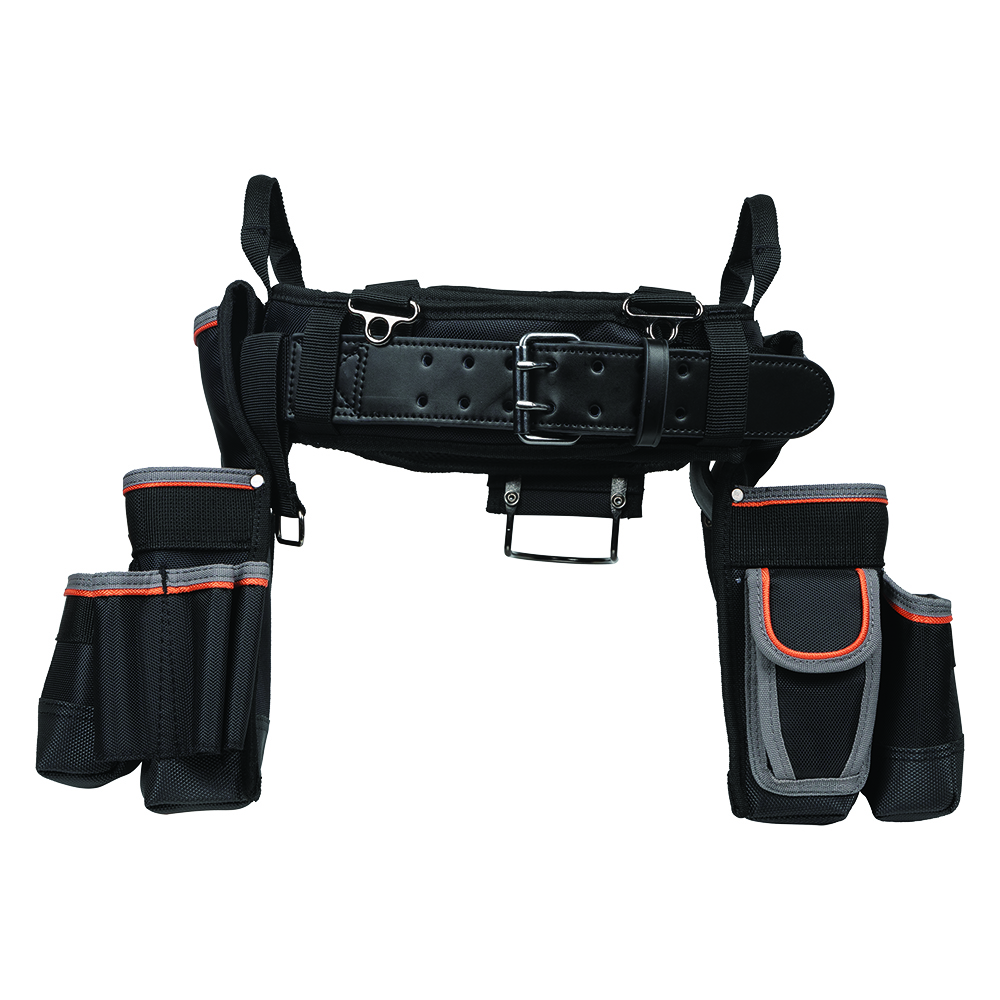
Who it's for: Residential and light commercial electricians who want a trade-specific, balanced belt without overspending.
The Klein Tools 55427 is the benchmark for electrician tool belts in the mid-range category, and it earns that position through genuinely thoughtful design rather than brand recognition alone.
Construction: Built from 1680D ballistic polyester weave with rugged leather belt ends. The leather ends provide the grip and durability of leather where it matters most — at the fastening point — while keeping the overall belt light.
Pocket layout: 26 pockets total, including a dedicated drill bit pocket, a tape measure loop, a hammer holder, and wide open pockets sized for drills and spare parts. The pouches are fully removable, so you can configure the belt for the specific job — a service call versus a new-construction rough-in require very different setups.
Ergonomics: The padded waistband with breathable mesh interior is the standout feature at this price point. It fits waist sizes 31–34 inches in the medium (S, L, XL also available), and includes attachment points for suspenders.
Weight: 4.2 lbs fully assembled (belt plus pouches, no tools).
What electricians say: The removable pouch system draws consistent praise — the ability to pull off the meter pouch and carry it to the panel separately, then reattach, is genuinely useful. The mesh padding keeps wearers cooler than most competitors at the same price.
The limitation: The 31–34" fit range means you need to be precise about sizing. Order a size up if you are in between.
Verdict: The 55427 hits the sweet spot of trade-specific design, build quality, and price. It is the belt most apprentices should start with and that many journeymen never need to replace.
2. Occidental Leather 5590 Commercial Electrician's Set — Premium Heritage Pick
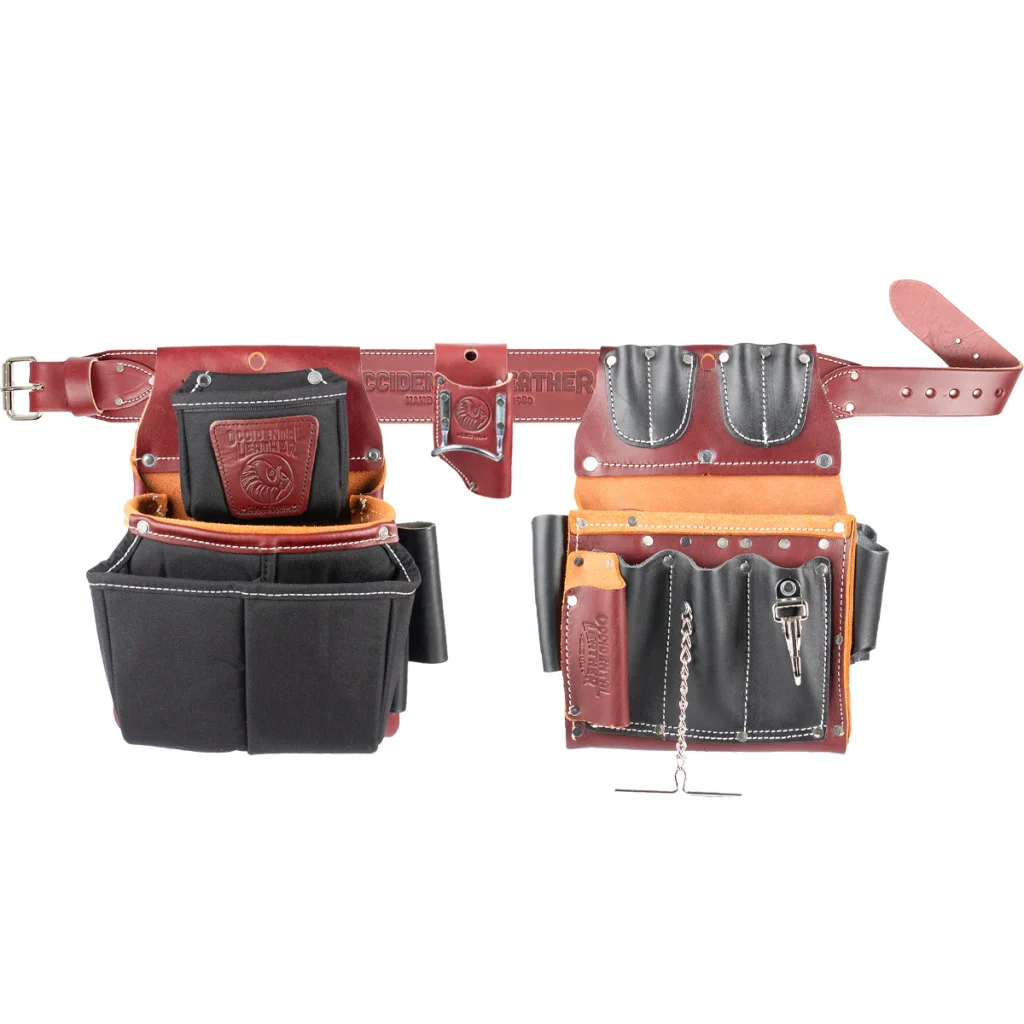
Who it's for: Career electricians who want a lifetime belt and are willing to pay for it.
Occidental Leather has been building trade belts since 1986, and the 5590 is their flagship commercial electrician set. It is hand-stitched, made entirely from premium top-grain leather, and built to outlast the career of most people who buy it.
Construction: Full top-grain leather throughout — no nylon panels, no synthetic stitching. All seams are hand-stitched and double-riveted at stress points. The belt will feel stiff for the first few weeks, but within 90 days of daily use it will have molded to the exact shape of your hips.
Pocket layout: 37 individual tool holders, including Occidental's patented NoSpill design — a proprietary pocket geometry that keeps tools from falling out even when the belt is inverted. This sounds like a marketing claim until you drop your belt on your head climbing out of an attic hatch and all your tools stay put. Hand-specific pouches mean the layout is optimized for dominant-hand tool retrieval, and left-handed versions are available.
Ergonomics: Heavier than nylon at around 4–5 lbs before loading. The trade-off is that leather conforms to your body in a way no synthetic material matches. After break-in, many veteran electricians describe it as a second skin.
Lifespan: With basic care (occasional leather conditioner, kept dry), 15–20 year lifespan is realistic and well-documented in the trade community.
What electricians say: The NoSpill holders are genuinely impressive. The hand-specific organization, once you adapt to it, makes tool retrieval faster than any other belt in this review. The leather quality is immediately apparent.
The limitation: Price. The 5590 set runs $280–$320, which is more than double the Klein. It also requires break-in time and is not ideal in wet environments without waterproofing treatment.
Verdict: The best electrician tool belt available if you are willing to invest. If you plan to be in the trade for 20+ years, the per-year cost is lower than any belt in this list.
For more on why leather is worth the premium, see our post on high-quality leather tool pouches being worth the investment for tradesmen.
3. Boulder Bag Ultimate Electrician MAX — Extreme Durability
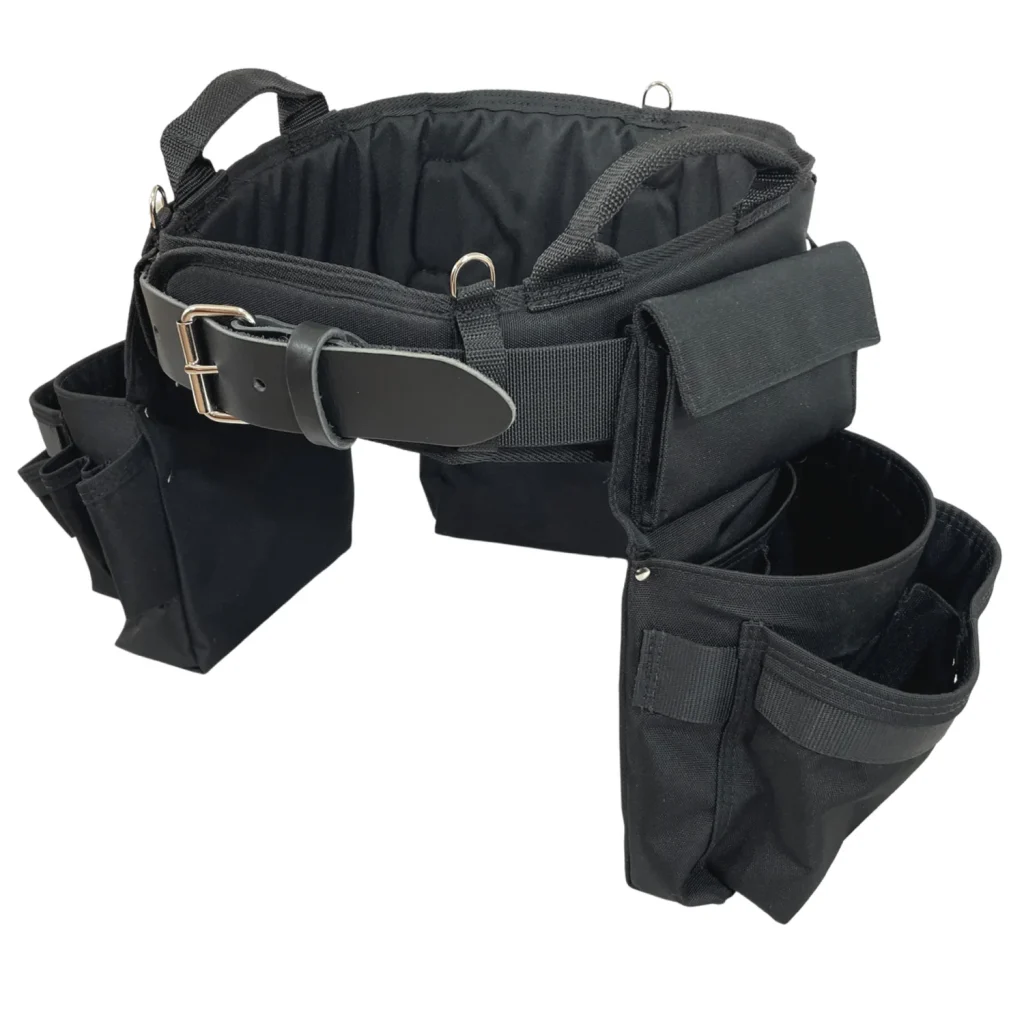
Who it's for: Industrial, heavy commercial, or outdoor electricians who destroy belts faster than most people buy them.
Boulder Bag is a smaller American manufacturer that builds specifically for heavy-use trades. The Ultimate Electrician MAX is made in the USA from military-grade Cordura — the same material used in military pack systems — rather than the standard 1680D ballistic nylon used by most competitors.
Construction: Military-spec Cordura with reinforced stress points, double-riveted at all pivot points, and triple-stitched seams. The result is a belt that is noticeably heavier and stiffer than the Klein but significantly more resistant to abrasion, tearing, and chemical exposure.
Pocket layout: 14 electrician-specific slots, fewer in number than the Klein or Occidental but each one deliberately sized for the tools electricians actually carry. There is no wasted space.
Ergonomics: Built-in lower back support panel — a semi-rigid foam insert in the rear section of the belt that reduces lumbar flexion during prolonged wear. This is the distinguishing feature at this price point and makes the MAX the best choice for electricians who work 10–12 hour shifts on commercial or industrial sites.
What electricians say: The lower-back support is noticeably different from standard padded belts — it actively maintains posture rather than just cushioning load. Durability reports from industrial electricians are consistently strong.
The limitation: Available direct from Boulder Bag or select specialty retailers — not as widely stocked as Klein or ToughBuilt. Lead times can run 1–2 weeks.
Verdict: The choice for electricians who work hard environments and need a belt that outlasts the job site.
4. Gatorback B240 Pro-Comfort — Best All-Day Comfort

Who it's for: Electricians who prioritize comfort for long shifts and those with existing back or hip concerns.
Gatorback built its reputation on comfort engineering, and the B240 is the most ergonomically advanced belt in this review.
Construction: Durable nylon with a focus on structural engineering rather than material weight. Available in six sizes from Small (26"–30") to 3XL (50"–55"), which is a notably broader sizing range than most competitors.
Pocket layout: Box-bottom pouches with hard plastic liners keep pockets open and rigid, allowing blind one-handed grabs — a genuine time-saver when you are working in a panel with your eyes on the circuit. The 2-inch web belt is flexible without being floppy, staying comfortable when crouching or climbing.
Ergonomics: This is where the Gatorback earns its category. The memory-foam padding is air-channel ventilated — not just a solid foam slab but a structured foam with channels that allow airflow against the skin. On a hot day or in a mechanically ventilated room, the difference is noticeable. The suspender attachment system is among the best available, with four anchor points that keep the belt from riding up during ladder work.
What electricians say: The ventilated padding gets the most consistent praise. Electricians who have had previous back or hip issues report significantly less discomfort at the end of a shift compared to other belts. The sizing range is appreciated by larger tradespeople who often struggle to find comfortable fits.
The limitation: The Velcro closure on some accessory pouches can weaken over time in dusty environments.
Verdict: The best choice if comfort is your primary criterion — especially for electricians with long shifts or existing ergonomic concerns.
5. ToughBuilt Journeyman Electrician Pouch — Best Modular / Budget Pick
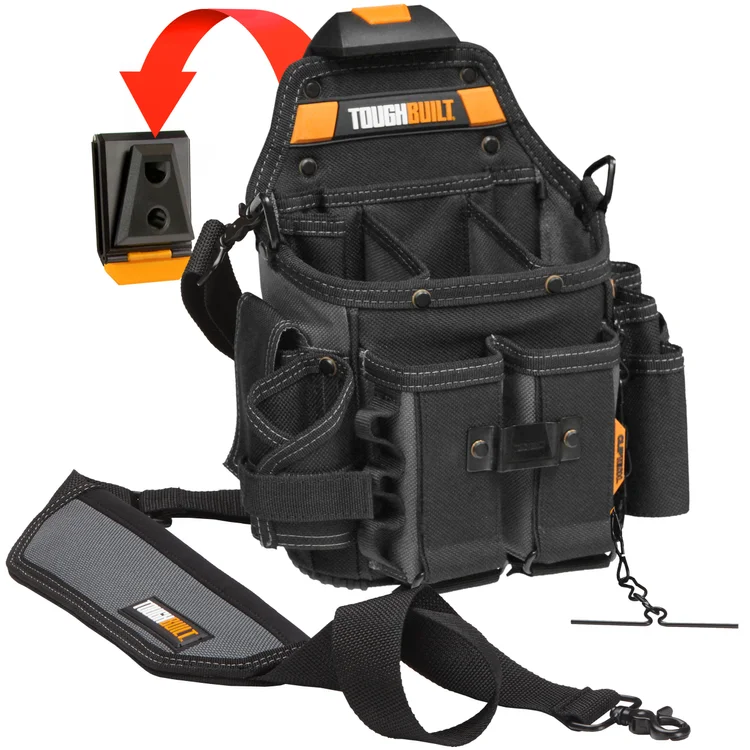
Who it's for: Apprentices, DIY electricians, and pros who want a modular system they can expand over time.
ToughBuilt's ClipTech system is the defining feature of the Journeyman pouch. Rather than a traditional integrated belt, the ToughBuilt uses patented clip mechanisms that allow you to snap and unsnap individual pouches from a rail system in seconds — no threading, no unbuckling, no tools required.
Construction: Durable nylon with reinforced stitching. Not as heavy-duty as the Boulder Bag or as refined as the Occidental, but solid for everyday use.
Pocket layout: Seven pockets configured specifically for electricians — slots for screwdrivers, voltage testers, wire strippers, and tape. The ClipTech rail system means you can add additional pouches from ToughBuilt's catalog as your needs grow.
Modularity: This is the real selling point. You can configure a minimal setup for service work — just the pouch you need — and expand to a full rig for new construction by clipping on additional pouches. You can also swap out a worn pouch without replacing the entire belt.
Price: Under $55 for the core pouch and belt — significantly below every other belt in this review.
What electricians say: The ClipTech system draws praise from apprentices who are still figuring out their preferences. Being able to reconfigure the belt between jobs without any tools is genuinely useful. At the price, it over-delivers.
The limitation: The clip mechanism, while convenient, adds wear points that can fail faster than traditional stitched pouches under heavy daily use. Heavy commercial electricians will outgrow the ToughBuilt faster than the other options here.
Verdict: The smartest entry-level choice, and a legitimate option for experienced electricians who want a lightweight, reconfigurable system for service work.
How to Choose the Right Belt for Your Work Type?
Not every electrician needs the same belt. Here is a quick decision framework:
Apprentice or first belt: Klein Tools 55427 or ToughBuilt Journeyman. Both are affordable, genuinely trade-specific, and will serve you well while you develop your preferences.
Residential service electrician: Klein 55427 or Gatorback B240. You need speed and comfort for multiple jobs per day, not maximum durability.
Commercial or industrial electrician: Occidental Leather 5590 or Boulder Bag MAX. You are working long shifts in demanding environments — invest accordingly.
Comfort is the priority: Gatorback B240, full stop.
Modular flexibility: ToughBuilt Journeyman.
Career investment, want a belt for life: Occidental Leather 5590.
If you are trying to decide between a tool belt and a tool bag for certain types of work, see our guide on the pros and cons of upgrading to a heavy-duty leather tool bag — there are specific scenarios where a bag outperforms a belt.
Tool Belt Maintenance: Making Your Investment Last
Even the best belt degrades fast without basic care.
Nylon belts: Wipe down with a damp cloth after every shift. Quarterly, hand wash with mild soap and allow to air dry fully before reloading. Do not machine dry — heat degrades the ballistic weave.
Leather belts: Wipe clean after every shift. Every 3–4 months, apply a thin coat of leather conditioner (neatsfoot oil or a dedicated product). Never expose to prolonged moisture — if the belt gets soaked, dry it naturally at room temperature, not with heat.
All belts: Inspect rivets and stitching monthly. A single failed rivet under a loaded pouch becomes a torn seam within days. Catch it early and have it repaired; replacing a rivet is a five-minute job that extends belt life by years.
Suspenders: Inspect the D-ring attachment points and strap hardware every month. Suspenders take the full static load of the belt — a failed attachment point under a loaded belt is a sudden 20-pound shock to your back.
Frequently Asked Questions
How much should I spend on an electrician tool belt?
For a working professional, $100–$150 is the minimum for a quality trade-specific belt. Below that threshold, you are buying a belt that will fail under daily professional use within a year. If you are a career electrician, the Occidental Leather at $280–$320 is genuinely cost-effective over a 15-year lifespan — roughly $20 per year.
Should I buy a complete set or build my own?
Complete sets (belt + pouches matched from the same manufacturer) are better engineered for load distribution and pocket-to-belt fit. Building your own rig from mixed brands can work, but requires more knowledge to get the balance right. For most electricians starting out, a matched set from Klein or Occidental is the right choice.
Do I really need suspenders?
If your loaded belt exceeds 15 pounds — which it will for any fully equipped journeyman — yes. The back health argument for suspenders is straightforward and well-documented in occupational health literature. Treat them as standard equipment, not an optional add-on. See our full guide to padded belts with suspenders.
What is the difference between an electrician belt and a carpenter belt?
Carpenter belts are built for wide, heavy tools — hammers, cats paw bars, speed squares, and nail guns. They feature large open dump pouches. Electrician belts feature narrow vertical slots, dedicated meter pockets, tape retention systems, and probe storage — designed for the slim, precision tools of electrical work. Using a carpenter belt for electrical work results in tools tangling, multimeters getting scratched, and tape rolls unraveling. For more context on how different trade belts compare, see our professional tool belts guide.
Can I use a tool pouch instead of a full belt?
For light service work or maintenance tasks, a quality belt-clip tool pouch can work well. See our post on why a belt-clip tool pouch is perfect for quick maintenance tasks for a full breakdown of when a pouch outperforms a full belt.
Final Thoughts
The right electrician tool belt is not a passive accessory. It is the organizational core of your daily workflow — the difference between reaching for the right tool in one second and digging around for five. Over the course of a career, that difference compounds into thousands of hours and, more importantly, into whether you arrive home at the end of a shift with your body intact.
Choose a belt that matches your actual work: the environments you work in, the shifts you pull, and the tools you carry every day. Use suspenders if you are loaded above 15 pounds. Get a padded meter pocket if you carry a digital multimeter (you should). And if you plan to be in this trade for the long haul, seriously consider the Occidental Leather — it is the kind of tool that improves with age.
For more on carrying and organizing your tools on the job site, explore our full guides on tool belt organization strategy and how to organize an electrician tool bag for maximum efficiency.