When you are knee-deep in a maintenance job — fixing a leaking pipe, patching drywall, or rewiring an outlet — the last thing you need is to waste minutes hunting for a screwdriver you set down "somewhere safe." Every tradesperson knows that frustration. It costs time, breaks concentration, and on an energized circuit or elevated platform, interruptions cost more than just time.
A belt clip tool pouch solves this problem in the most direct way possible: the tools you reach for most often stay clipped to your body, always within one second of your hand. No trips back to the toolbox. No digging through a bag on the floor.
This guide covers everything you need to know about belt clip tool pouches in 2026 — what separates a quality pouch from a cheap one, which trades benefit most, detailed reviews of the five best options on the market right now, and a clear framework for choosing the right pouch for your specific work.
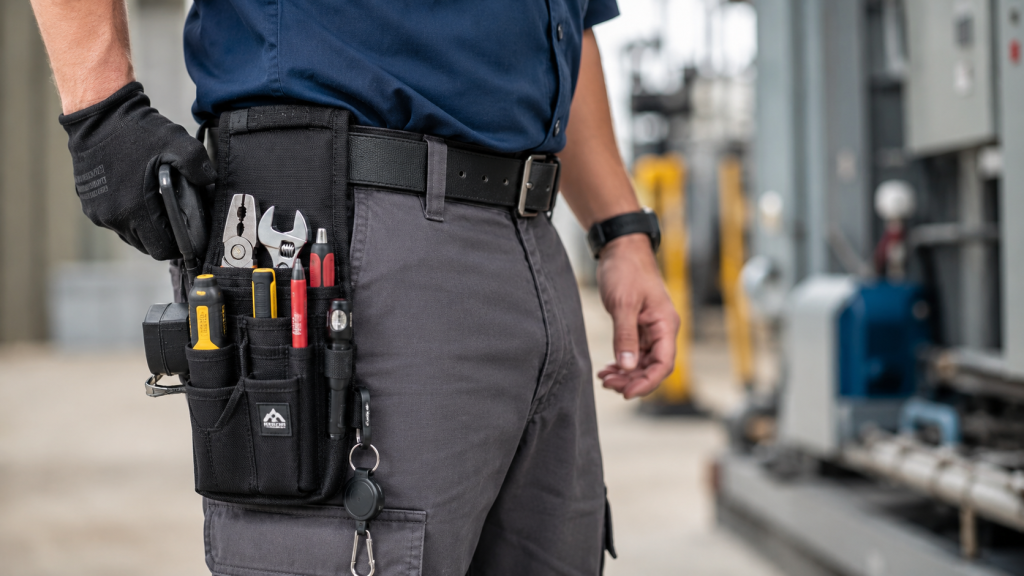
What Is a Belt Clip Tool Pouch — And Why Does It Matter?
A belt clip tool pouch is a compact, wearable organizer — typically made from leather, ballistic nylon, or heavy-duty canvas — designed to hang from a belt or clip directly onto a waistband using a reinforced metal or hardened plastic clip. Unlike a full tool belt or a tool bag set on the floor, a belt clip pouch is intentionally minimalist: it carries a curated set of your most-used tools, not your entire kit.
Most pouches run between 8 and 14 pockets, including a large main compartment, narrow vertical slots for screwdrivers and wire strippers, sleeve pockets for a voltage tester or flashlight, tape loops or chains, and a carabiner point for keys or tool lanyards.
The key distinction from a full tool belt is targeted daily carry. A full belt is your complete tool station for a new-construction job or all-day installation work. A belt clip pouch is your rapid-response rig for service calls, maintenance rounds, and quick repairs — situations where carrying a full rig would slow you down more than it helps.
If you are also evaluating when a full belt setup makes more sense, our detailed post on best electrician tool belt features walks through exactly that comparison.
Who Actually Benefits from a Belt Clip Tool Pouch?
Belt clip pouches are not for everyone on every job. They shine in specific work contexts:
Facilities maintenance technicians doing multiple task types throughout a shift — electrical, plumbing, HVAC, carpentry — who need a lightweight, versatile carry that does not slow them down between rooms.
Electricians on service calls who are diagnosing problems and making repairs rather than running new circuits. A service call requires testers, screwdrivers, tape, and a multimeter — not a 26-pocket installation rig.
HVAC technicians constantly climbing in and out of equipment rooms, attics, and crawlspaces. Both hands need to be free, and bulk that snags on ductwork is a safety hazard.
Plumbers on residential service — fitting a shut-off valve or snaking a drain does not require a full belt.
Property managers and DIY homeowners who handle their own maintenance and want a practical carry without investing in a full professional rig.
Apprentices who are building their first tool carry setup before they develop clear preferences for a full belt system.
The common thread: jobs that are about speed and mobility, not about carrying maximum gear.
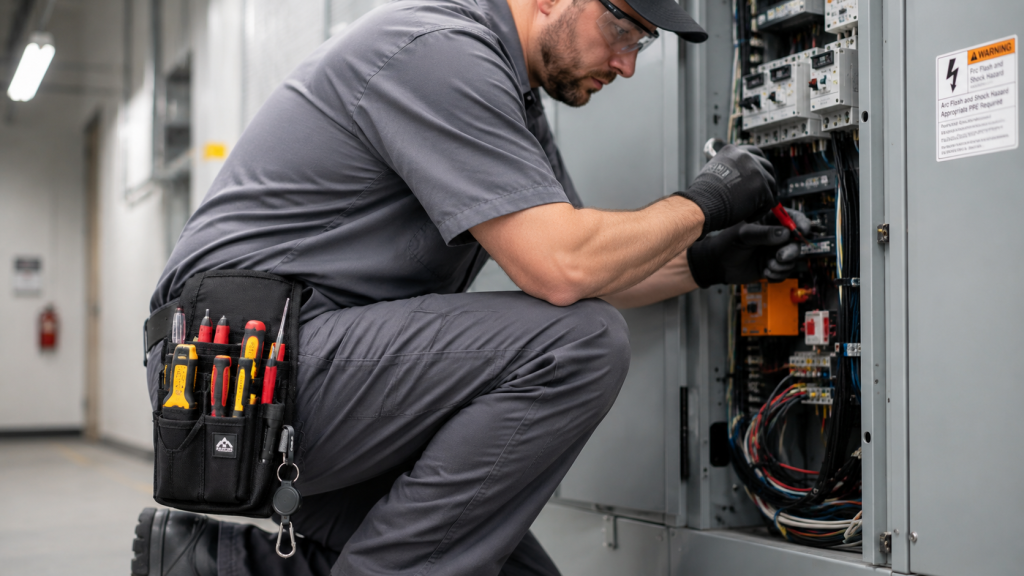
5 Features That Separate a Quality Pouch from a Cheap One
Not all pouches are created equal. A $12 pouch will fail at the seams within three months of daily professional use. Here is exactly what to evaluate.
1. Clip Mechanism Strength and Security
The clip is the single most critical component of any belt pouch. It needs to carry a loaded pouch — which can weigh 5–8 lbs fully equipped — through a full shift of bending, climbing, and crouching without disengaging.
Look for: Forged or reinforced stamped metal clips with a positive-locking mechanism and a belt compatibility range of at least 2–2¾ inches.
Avoid: Lightweight plastic clips with no locking feature. They deform under sustained load and pop open on ladder rungs — exactly when a dropped tool is most dangerous.
Most quality pouches offer two attachment options: a rear metal clip and a tunnel belt loop as a backup. Dual attachment means you can adapt to different waistband configurations without compromising security.
2. Pocket Layout Matched to Your Trade
A general-contractor pouch will frustrate an electrician who needs a dedicated meter pocket and tape chain. An electrician-specific pouch will be undersized for a plumber who needs space for adjustable wrenches.
Before buying, list the six to ten tools you reach for most in a typical shift. That list is your purchase criteria. A pouch that fits those tools in accessible, clearly organized slots is worth far more than one with more pockets that makes retrieval slow and frustrating.
For a detailed framework for thinking through tool carry organization, see our guide on tool belt organization strategy.
3. Material and Build Quality
Ballistic nylon (1680D): Lightweight, chemical-resistant, quick-drying. Best for wet environments, outdoor work, and multi-trade maintenance. Easy to wipe clean.
Top-grain or nubuck leather: Heavier, but molds to your tool shapes over time. Handles abrasion and sharp edges better than nylon. Ideal for dry indoor environments and electricians who want a long-lasting investment. Requires occasional conditioning.
Canvas: Breathable, moderately durable, affordable. Good for lighter daily use but less abrasion-resistant than nylon or leather.
For a full breakdown of how these materials compare across trades and environments, see what is the best material for a tool belt. If leather pouches specifically interest you, our post on whether a high-quality leather tool pouch is worth the investment gives an honest breakdown.
Regardless of material, look for double or triple stitching at all stress points and copper or steel rivets at the pivot corners where tool weight concentrates.
4. Rigid Box-Bottom Construction
Open-top, floppy pouches lose their shape under load. Tools tilt, tangle, and require two-handed retrieval — which defeats the whole purpose of a hip-carry pouch.
Quality pouches use box-bottom construction: a rigid base plate or hard plastic liner that keeps the pouch standing open and upright at all times. This allows true one-handed blind grabs even when you are pressed against a wall or bent into a panel.
This is one of the most overlooked features when people shop by price alone, and one of the clearest differences between a $20 and a $40 pouch.
5. Padded Rear Panel Against the Body
After a full shift of bending, kneeling, and reaching, the edge of a hard-bodied pouch with no padding becomes a pressure point against your hip. Good pouches include a foam-backed or padded rear panel that distributes contact across the hip rather than concentrating it at one point.
This is especially important for maintenance techs who spend significant time crouched or in confined spaces.
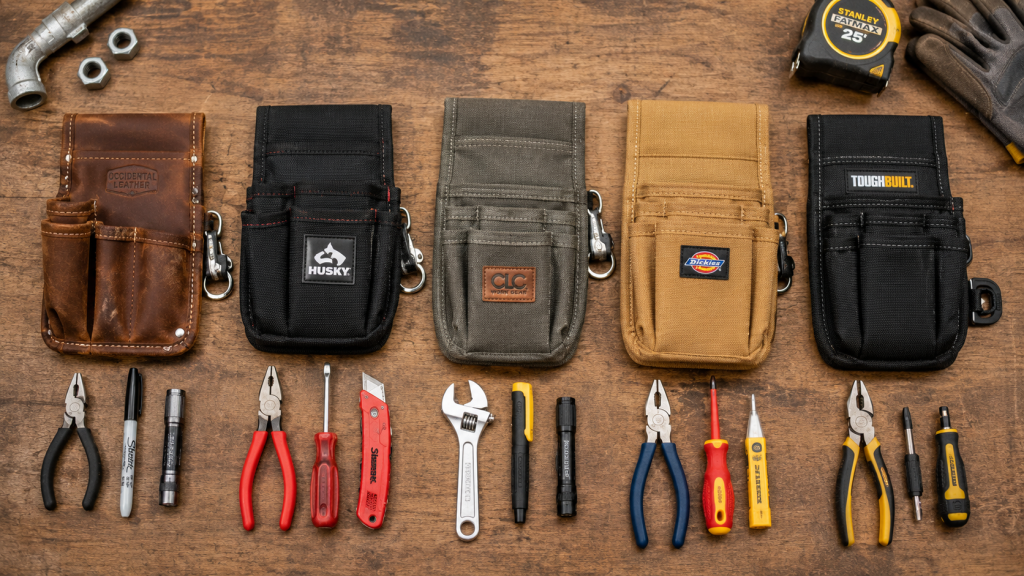
The 5 Best Belt Clip Tool Pouches for 2026
After evaluating construction quality, pocket layout, clip security, user feedback from trade communities, and real-world specifications, these five pouches represent the best in their categories.
| # | Pouch | Best For | Price |
|---|---|---|---|
| 1 | Klein Tools 5240 Tradesman Pro | Best Overall | ~$25–$35 |
| 2 | DEWALT DG5103 Small Maintenance Pouch | Best Service Call Pouch | ~$20–$28 |
| 3 | ToughBuilt ClipTech Electrician Pouch | Best Modular System | ~$30–$45 |
| 4 | AWP Mini Electrician Tool Pouch | Best Compact / Budget | Under $20 |
| 5 | DEWALT 12-Pocket Leather Pouch | Best Heavy-Duty Leather | ~$55–$75 |
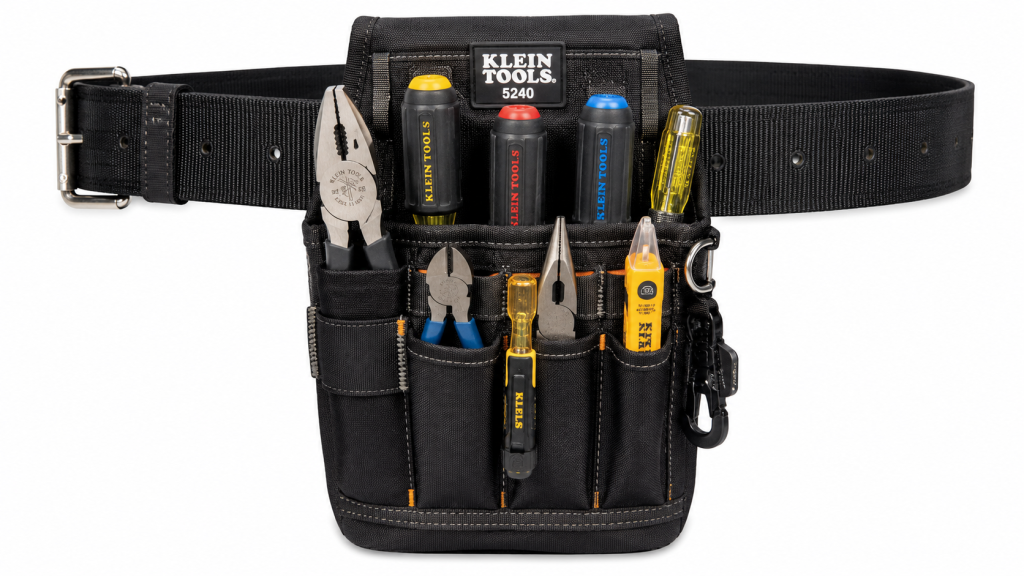
1. Klein Tools 5240 Tradesman Pro — Best Overall
Who it's for: Electricians and maintenance techs who want a lightweight, well-organized everyday pouch that works cleanly on any belt.
Klein built the 5240 specifically for maintenance and electrical service work, and it shows in every design decision. This is not a generic pouch adapted for trade use — it is purpose-built from the ground up for the workflow of someone doing multiple service tasks per day.
Specifications:
- 9 pockets plus dedicated tape thong
- 2-inch tunnel loop for standard belt attachment
- Dimensions: 10.25" × 5.5" × 10.25"
- Material: Durable heavy-duty nylon
- Weight: Light enough for all-day wear
What makes it stand out: The tape thong — a dedicated strap that keeps a roll of electrical tape secured and immediately accessible — is a feature that matters enormously in practice. The 9-pocket layout is calibrated for the tools an electrician or maintenance tech actually carries: screwdrivers, pliers, a voltage tester, a tape measure, wire nuts, and spare bits. Nothing is oversized, nothing is wasted.
The 2-inch tunnel loop fits virtually every standard work belt and keeps the pouch from swinging during ladder work. Klein also designed it to work as part of their broader Tradesman Pro system — you can pair it with a Klein padded belt and additional pouches if your workload expands.
What electricians and maintenance techs say: Consistent praise for the organizational layout and the fact that every tool has a home that makes sense. The tape thong draws specific mention from electricians who previously lost rolls constantly in open-pocket pouches.
The limitation: The tunnel loop is fixed — there is no quick-release metal clip option for those who want to detach the pouch without threading a belt.
Verdict: The most refined, purpose-built option for electricians and general maintenance work at this price. If you do not have a strong preference for another brand's system, this is the default best choice.
2. DEWALT DG5103 Small Maintenance Pouch — Best for Service Calls
Who it's for: Contractors, maintenance techs, and HVAC and plumbing service technicians who need a true grab-and-go system for rapid response work.
DEWALT describes the DG5103 as a "grab-and-go tool system," and that framing captures exactly what it does well. The trapezoid body shape is intentional engineering — it prevents the pouch from swinging as you walk or climb ladders, which is a significant comfort and safety advantage over rectangular designs.
Specifications:
- Large main pocket + smaller front pocket
- Web loops, sleeve pockets for flashlight/large tool
- Electrical tape strap plus carabiner for keys
- Dual attachment: rear metal clip OR belt up to 2¾" wide
- Material: Ballistic poly fabric with reinforced edges
What makes it stand out: The dual attachment is genuinely useful. The rear metal clip means you can put the pouch on and take it off in seconds — no belt threading required. For service techs who move between a van, a building, and multiple units per day, that convenience adds up. The carabiner attachment point for keys is a small touch that eliminates the "I set my keys down somewhere" problem that plagues service calls.
The flashlight sleeve is a well-thought-out inclusion — most maintenance calls involve at least one look into a dark cabinet or utility closet, and having the light clipped to your hip rather than sitting on a shelf somewhere means it is always with you.
What users say: Widely praised by HVAC technicians and property maintenance workers for how naturally it disappears into a daily workflow. The trapezoid shape earns specific mention for how stable it feels versus standard rectangular pouches.
The limitation: The ballistic poly material, while durable, is not as abrasion-resistant as leather or military-grade Cordura. In very high-abrasion environments, the edges show wear over 12–18 months of heavy use.
Verdict: The best pouch for service-call work specifically. If your day involves getting in and out of a vehicle between jobs, the clip-on/off speed of the DG5103 is genuinely valuable.
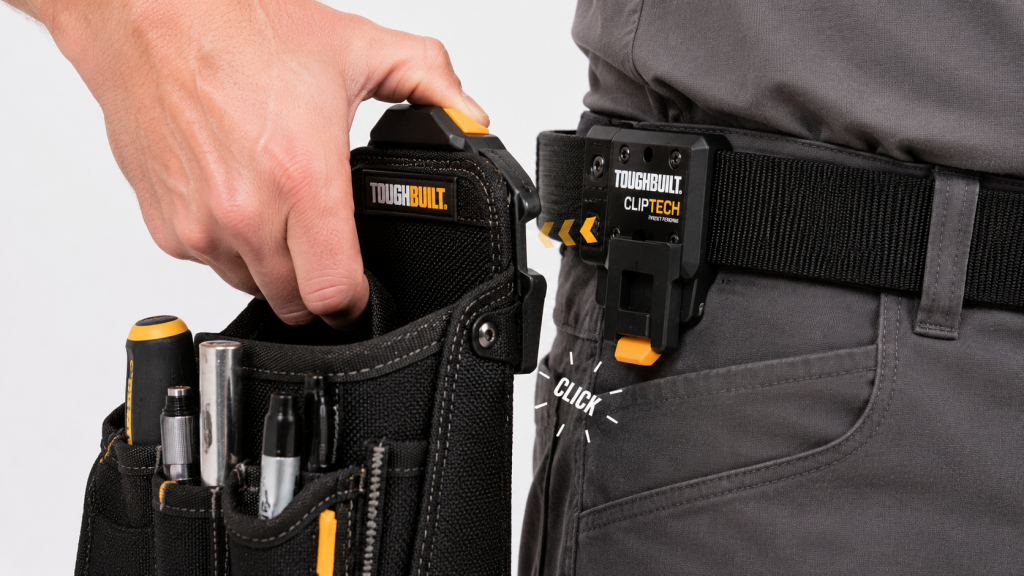
3. ToughBuilt ClipTech Electrician Pouch — Best Modular System
Who it's for: Anyone who wants a reconfigurable carry system that adapts as their tool needs change — and electricians who already use ToughBuilt's belt ecosystem.
ToughBuilt's ClipTech system is the most genuinely different approach to belt pouch design in this review. Rather than a traditional fixed attachment, ClipTech uses a patented snap-clip hub that allows the pouch to clip on and off any ClipTech-compatible belt in about two seconds — no tools, no threading, no unbuckling.
Specifications:
- 13+ pockets including internal organization pockets
- ClipTech Hub for instant belt attachment/removal
- Integrated kickstand that holds the pouch upright on the ground
- 6-layer construction with heavy-duty rivet reinforcements
- Material: Heavy-duty nylon throughout with rubber-reinforced bottom
What makes it stand out: Three things, specifically. First, the ClipTech system means you can pull the entire pouch off your belt, hand it to someone, or set it down and keep working — then re-attach in seconds when you move. Second, the integrated kickstand keeps the pouch standing upright on the floor next to you, so tools remain accessible without the pouch tipping over. Third, the 13-pocket layout is spacious enough that it handles nearly any trade's daily carry requirements without compromise.
The 6-layer body construction is noticeably sturdier than the DEWALT or Klein options — this pouch is built for heavy commercial use, not just light maintenance.
What users say: The ClipTech hub draws near-universal praise for the convenience it adds to multi-task workdays. The kickstand feature gets mentioned repeatedly as something that sounds like a gimmick but turns out to be genuinely useful in practice.
The limitation: The tape chain is longer than strictly necessary, which can cause it to sling into the pouch opening when reaching for tools. A minor nuisance rather than a real problem, but worth knowing.
Verdict: The best choice for anyone who values flexibility and plans to expand their carry system over time. Also the best-built pouch at this price point for commercial or industrial use.
4. AWP Mini Electrician Tool Pouch — Best Compact / Budget Option
Who it's for: Apprentices, DIY homeowners, and anyone who needs a lightweight entry-level pouch without a significant financial commitment.
The AWP Mini is the most affordable quality pouch in this review, and it over-delivers for its price. It is genuinely small — which is either a selling point or a dealbreaker depending on what you carry.
Specifications:
- Compact form factor with multiple pockets
- Metal clip or traditional tunnel loop attachment options
- Electrical tape tether and carabiner for small items
- Material: Ballistic nylon
What makes it stand out: The dual attachment system (clip or loop) gives flexibility that more expensive pouches sometimes omit. The electrical tape tether is a practical inclusion even at this price point. The overall build is solid — the fabric does not feel thin or cheap, and the stitching holds up to daily use.
For anyone who does occasional maintenance tasks and wants a pouch for light daily carry — a screwdriver, a voltage tester, a utility knife, and some tape — the AWP does exactly that job without overspending.
What users say: Strong reviews as a compact secondary pouch added to an existing full belt, or as a standalone for light maintenance work. The metal clip gets consistent positive mention for its strength relative to the price.
The limitation: It is genuinely small. Professional electricians or maintenance techs with a heavy daily tool carry will hit the capacity limits quickly. This is a light-use or entry-level option, not a primary pouch for heavy commercial work.
Verdict: The smartest budget choice. Buy it as a starter pouch or as a compact secondary carry added to a full belt setup.
5. DEWALT 12-Pocket Leather Pouch — Best Heavy-Duty Leather Option
Who it's for: Experienced tradespeople who want a pouch that will last a decade and who work in dry, high-abrasion environments where leather outperforms nylon.
DEWALT's leather pouch is the most premium single-pouch option in this review — built from nubuck top-grain leather with reinforced rivets and double stitching throughout.
Specifications:
- 12 pockets including two side sleeves
- Quick-grab tape clip on exterior
- Heavy-duty webbing belt with double-tongue roller buckle
- Material: Nubuck top-grain leather with reinforced stress points
What makes it stand out: Leather's natural abrasion resistance means this pouch handles hard edges, rough concrete, conduit burrs, and tool-on-tool contact far better than nylon over multi-year use. The nubuck finish is more scuff-resistant than smooth leather while retaining the structural advantages. The 12-pocket layout is the most comprehensive in this review, accommodating a full service electrician's daily carry without forcing compromises.
The double-tongue roller buckle belt is more secure under load than the single-buckle systems on nylon pouches — particularly relevant if your pouch is fully loaded and you are working in positions where the belt flexes.
For more on why leather tool carry is worth the premium for long-term professional use, see traditional leather tool belt craftsmanship and our guide on the pros and cons of upgrading to a heavy-duty leather tool bag.
What users say: Electricians and contractors who have used DEWALT's nylon pouches for years report noticeably better long-term durability with the leather option. The break-in period is about two to three weeks before the pouch begins to mold to your specific tools.
The limitation: Leather requires occasional conditioning and should not be left wet. It is also heavier than nylon before loading. In consistently damp environments — outdoor construction in rainy climates, plumbing work — nylon remains the smarter material choice.
Verdict: The best option if you want a pouch that improves with age and lasts far longer than a nylon alternative. A genuine long-term investment for experienced tradespeople.
Belt Clip Pouch vs. Full Tool Belt: Which Should You Use?
This is the question most maintenance workers face, and the answer depends on what your typical day looks like.
Use a belt clip pouch when:
- You are doing service calls or maintenance rounds with a repeating set of 6–10 tools
- Mobility and speed between tasks matters more than carrying capacity
- You work in tight spaces — crawlspaces, ceiling voids, equipment rooms — where a full belt snags
- You are supplementing a tool bag or toolbox rather than replacing it
Use a full tool belt when:
- You are doing new installation work that requires 15+ tools simultaneously
- You are on-site for an 8–12 hour shift doing one type of work
- You need suspenders to distribute weight — meaning your total carried load exceeds 15 lbs
- Your work involves a standardized tool set you carry every single day
Use both when:
- You have a full belt for installation work but clip a dedicated service pouch for troubleshooting rounds
- You want to carry a modular secondary pouch (tape, connectors, small parts) alongside your main belt setup
For a comprehensive guide to full belt systems, see our professional tool belts guide.

How to Load Your Belt Clip Pouch for Maximum Efficiency?
Buying a good pouch is only half the decision. How you load it determines whether you can actually retrieve tools quickly in the field.
Dominant-hand rule: Your most-used tool goes in the slot closest to your dominant hand, at the height where your hand naturally drops. This is typically the front-facing screwdriver slot on the right side (for right-handed users). Every reach for that tool should feel automatic — no looking, no adjusting grip.
Voltage tester at the top: If you carry a non-contact voltage tester, it should always be in the highest, most accessible slot. It is the first tool you reach for on any unfamiliar circuit, and having it immediately available is a safety habit as much as an efficiency one.
Tape at the exterior: If your pouch has an exterior tape clip or chain, use it. Tape rolls buried in the main compartment become tangled and slow to retrieve. Exterior retention keeps tape accessible one-handed.
Heavy items toward the body: Heavier tools (multimeter, pliers) should sit in pockets closest to the rear of the pouch, near your body. This keeps the center of mass close to your hip and prevents the pouch from swinging forward during movement.
Leave the main compartment accessible: Resist the temptation to stuff the main compartment with consumables and wire nuts until it is packed tight. A lightly loaded main compartment that opens easily is more valuable than maximum stuffing that requires two hands to access.
For more on how to structure your overall tool carry system — not just the pouch but the bag, belt, and organization strategy together — see our guide on how to organize an electrician tool bag for maximum efficiency.
Maintaining Your Belt Clip Pouch
Even the best pouch degrades without basic care.
Nylon and ballistic poly pouches: Wipe down with a damp cloth after each shift. Monthly, hand wash with mild soap and air dry fully before reloading. Do not machine dry — heat degrades the synthetic weave at the stress points.
Leather pouches: Wipe down after each shift. Every 3–4 months, apply a thin coat of leather conditioner. If the pouch gets soaked, dry at room temperature — not with heat. Never leave a wet leather pouch folded or compressed, as it will deform as it dries.
All pouches: Inspect the clip mechanism and belt attachment monthly. A clip that shows deformation or a tunnel loop that shows fraying should be replaced before it fails under load. A clip failure mid-shift with a loaded pouch is a dropped tool or a stumble — neither of which is acceptable in a live work environment.
Frequently Asked Questions
What is the difference between a tool pouch and a tool bag?
A tool pouch attaches to your body — belt, waistband, or harness — and carries a small curated set of daily tools. A tool bag sits on the floor or in a vehicle and carries your full kit. Most professionals use both: the bag stays at the vehicle or job base, the pouch travels with them through the building. See our post on why a belt-clip tool pouch is perfect for quick maintenance tasks for a deeper look at when each format makes sense.
How many tools should I carry in a belt clip pouch?
Six to ten tools is the practical range for a daily belt pouch. Below six, you will be making frequent trips back to your bag. Above ten, the pouch gets heavy enough that a full belt starts to make more ergonomic sense. If you consistently find yourself needing more than ten tools simultaneously, evaluate whether a full belt setup is a better fit.
Can I use a belt clip pouch on a full tool belt?
Yes, and many experienced tradespeople do exactly this. A clip pouch added to a full belt typically carries consumables (tape, wire nuts, connectors) or a secondary specialty tool set — freeing up the main belt pouches for core tools. ToughBuilt's ClipTech system is particularly well suited to this hybrid setup.
What is the best belt clip tool pouch for an electrician specifically?
The Klein Tools 5240 Tradesman Pro is the most purpose-built option for electrical work specifically, with its tape thong, screwdriver slots, and compact layout for service calls. For modular expansion, the ToughBuilt ClipTech is the better long-term choice.
How long should a quality belt clip pouch last?
A quality nylon pouch from Klein, DEWALT, or ToughBuilt should last 3–5 years of daily professional use with basic care. A quality leather pouch can last 10–15 years. Cheap pouches — regardless of brand — typically fail at the clip or seams within 6–12 months of daily use. Buy once at a reasonable quality level and avoid replacing cheap pouches annually.
Final Thoughts
A belt clip tool pouch is not complicated equipment. It does not have a digital feature, a premium brand story, or an impressive price tag. What it has is something far more valuable in actual daily work: it puts the right tool in your hand the moment you need it, without interrupting your workflow or your concentration.
For quick maintenance tasks — the ten-minute repairs, the mid-shift adjustments, the service-call diagnostics — a good belt clip pouch is not a convenience. It is the most efficient tool carry decision you can make.
Buy the pouch that matches your specific work: your trade, your daily tool list, your environment. Load it with intention. And notice how much smoother every job becomes from the first day you stop setting tools down "somewhere safe."
For more on building a complete tool carry system — from belt to bag to organizer — explore our full guides on tool belt organization strategy and transforming a cluttered tote with a dedicated tool bag organizer.